The Wonders of Creation
Book One: The Heavens — the author's introductions and the upper world
- Original title
- عجائب المخلوقات وغرائب الموجودات
- Author
- Zakariyya al-Qazwini (c. 1203–1283)
- Written
- Iraq, mid-13th century (before 1283)
- Original language
- Arabic
- Culture
- Islamic
- Published so far
- 1 of 14 chapters · next 10 Nov · 5,259 words · 23 min read
About this book
Introduction
The author. Zakariyya ibn Muhammad ibn Mahmud al-Qazwini was born around 1203 in Qazwin in northern Persia, into a family of jurists. He left his homeland as a young man. In his preface he speaks of being "far from home and homeland", and that exile was probably bound up with the Mongol invasions of his lifetime. He spent most of his career in Iraq, where he served as a judge in Wasit and al-Hilla, and he died in 1283. Besides this book he wrote a geography, Āthār al-bilād ("Monuments of the Lands"). That work is not translated here.
The book. ʿAjāʾib al-makhlūqāt wa-gharāʾib al-mawjūdāt, "The Wonders of Created Things and the Marvels of Existing Things", is the most widely read cosmography of the medieval Islamic world. It was copied, illustrated and translated into Persian, Turkish and other languages for six centuries. After four introductions, al-Qazwini moves from the outermost heavens down to the earth, in two discourses. The first, on the "upper things", covers the spheres, the planets, the fixed stars and constellations, the lunar mansions, the angels, and the reckoning of days, months and years. The second, on the "lower things", covers the elements, the seas and their islands and creatures, the mountains and rivers, the minerals, the plants, man, the jinn, and every kind of animal, and it ends with strange and composite beings. On this site the work is published in two books along that natural division. This is Book One, the heavens; the lower world follows in Book Two.
What Book One contains. It opens with al-Qazwini's preface and his four introductions: on wonder, on the division of created things, on the marvel, and on the division of existing things. Then comes his plan of the whole work. The First Discourse then climbs from the sphere of the moon through the spheres of the planets to the fixed stars. There he gives the forty-eight constellations of Ptolemy with the Arabic names of their stars, and the twenty-eight mansions of the moon with the weather lore and rhymed sayings that the Arabs attached to each. Above the stars he describes the sphere of the zodiac, the outermost sphere, the Throne and the Footstool, and the angels who inhabit the heavens, from the bearers of the Throne to the angels who tend each created thing. The discourse closes with time itself: the days of the week and their virtues, the months of the Arabs, the Syrians and the Persians with their feasts and customs, and the years and the four seasons. The last section ends with the tale of al-Khidr and the city that became a desert, a sea and a city again.
How to read it. Al-Qazwini wrote to instruct and to delight. He sets out what the learned of his day held true about the cosmos, and his preface states plainly that what he reports falls into three kinds:
- wonders of God's handiwork that he regards as certain;
- "charming stories" that he ascribes to those who told them and for which he takes no responsibility;
- "strange properties" of things, which the reader is invited to test for himself.
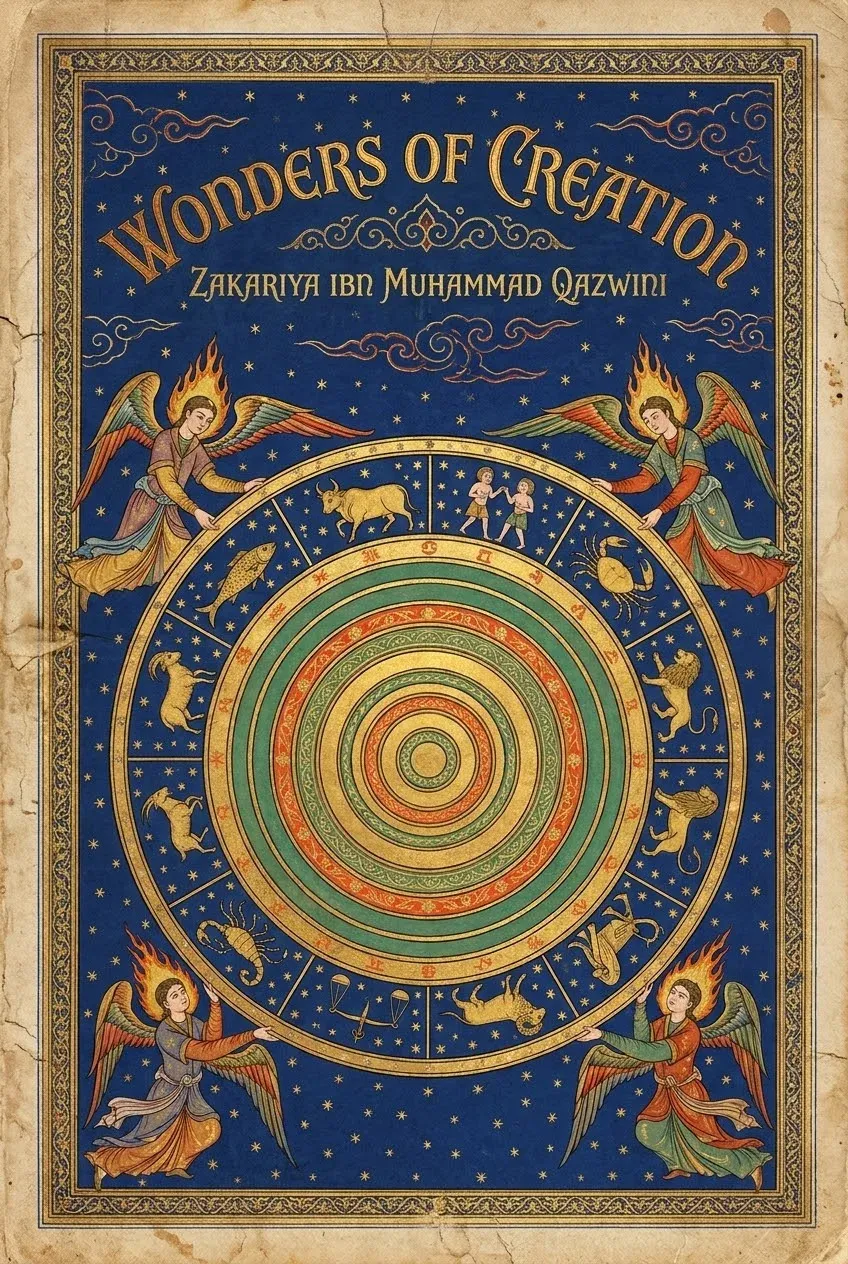
His formulas "they say", "it is said", "they claim" and "God knows best" mark these distinctions, and they are kept in the translation. The book reflects thirteenth-century knowledge, including astrology, magical and medical recipes, and descriptions of peoples, some of which a modern reader will find strange or offensive. They are translated faithfully. Nothing is softened, and the only comment added is what is needed to understand them. Nothing in the book should be taken as medical advice. The cover and the illustration at the start of the book are modern images generated with AI for this edition: they are not old artwork and do not come from Wüstenfeld's edition or from any manuscript of the work.
About this translation. The translation is made from the Arabic text of Ferdinand Wüstenfeld's edition (Göttingen, 1849), which is based on manuscripts in Berlin, Gotha, Dresden and Hamburg. The text was read from the page images of the print, with machine readings (OCR) used as a check. Wüstenfeld's own preface is not reproduced. His critical apparatus records manuscript variants in footnotes, and a variant is mentioned in a note when it matters for the sense, especially for names and numbers.
Notes marked Tr. record the translator's decisions: an uncertain reading, a variant, a misprint kept as printed, or a word corrected from the sense. Nothing has been added to the text. Wording that cannot be read is marked [illegible] or flagged in a note.
The print contains a number of diagrams and tables: figures of the spheres, tables of the first days of the months and a calendar wheel. These are not reproduced, and a note marks each place where the author refers to one.
Conventions. - Arabic names are given in a simplified transliteration in the running text (al-Qazwini, Saʿid ibn Jubayr). Technical terms are given in full transliteration in italics at their first appearance and in the notes (ʿajab, anwāʾ). - Star names are transliterated, with a translation in quotation marks at their first appearance, for example al-Jady, "the Kid". The modern identification of the star is given in a note. - The rhymed weather sayings of the lunar mansions (sajʿ) are set as short lines. They are translated for sense, without imitating the rhyme. - Qurʾanic verses are translated afresh and printed in italics; sura and verse are given in the notes. - The page range in Wüstenfeld's edition is given in the source line at the end of each chapter.
Contents
- The Author's Preface and the First Two Introductions [Khuṭbat al-kitāb]; al-Muqaddima al-ūlā fī sharḥ al-ʿajab; al-Muqaddima al-thāniya fī taqsīm al-makhlūqāt, pp. 3–9 23 min read
Next chapter: Tuesday, 10 November. 13 more chapters to come. Follow via RSS.