Poetic Views of the Slavs on Nature, Volume III
Demons, death and disease, cloud maidens, the souls of the dead, fate, witches and werewolves, and the old festivals of the year
- Original title
- Поэтическія воззрѣнія славянъ на природу. Томъ третій
- Author
- Alexander Afanasyev (1826–1871)
- Written
- Moscow, 1869
- Original language
- Russian
- Culture
- Slavic
- Published so far
- 1 of 47 chapters · next 9 Nov · 5,183 words · 23 min read
About this book
Alexander Afanasyev (1826–1871) is known to every reader of fairy tales as the man who collected and published the Russian Folk Tales, the Russian counterpart of the brothers Grimm. Less well known is that he also wrote one of the great works of nineteenth-century mythology: Poetic Views of the Slavs on Nature (Poeticheskie vozzreniya slavyan na prirodu), published in three large volumes in Moscow between 1865 and 1869. Its subtitle describes it as "an attempt at a comparative study of Slavic traditions and beliefs in connection with the mythical tales of other related peoples". As far as we know, it has never been translated into English. This book is volume III, translated from beginning to end.
What is in this volume. Volume III gathers the darker side of Slavic belief. It begins with the unclean powers: the devil and his kin, hell and its torments, Morana and Death, and the demons of disease, the fever sisters and the plague woman. It goes on to the cloud wives and maidens (rusalkas, vilas, the noon-women and the swan maidens), to the souls of the dead, and to the maidens of fate. Its longest chapter deals with wizards, witches, vampires and werewolves, and with Baba Yaga. Then come the trials of sorcerers and witches in old Russia, and finally the festivals of the year, from the driving out of Death in spring to Kupala and Kolyada. Afanasyev quotes hundreds of beliefs, charms, songs, laments, proverbs and tales that he and others had recorded among the Russian, Ukrainian, Belarusian, Polish, Czech, Slovak, Serbian, Bulgarian and Lusatian peoples, and sets them beside the myths of India, Greece, Rome, Scandinavia and Germany.
A word about the theory. Afanasyev belonged to the "mythological school" of his day. Like Max Müller and Adalbert Kuhn, he believed that myths grew out of poetic language about nature, above all about the sky: the thunder god and the storm cloud, the sun, rain, wind and winter. So he reads the devil's limp as the zigzag of lightning, hell as the inside of a storm cloud, and the fevers as cloud maidens. Few scholars would explain myth this way today. But the book's lasting value lies elsewhere: in the enormous body of folk belief it records, much of it from sources hard to find even in Russian, and in its picture of how a learned Russian of the 1860s understood his people's past.
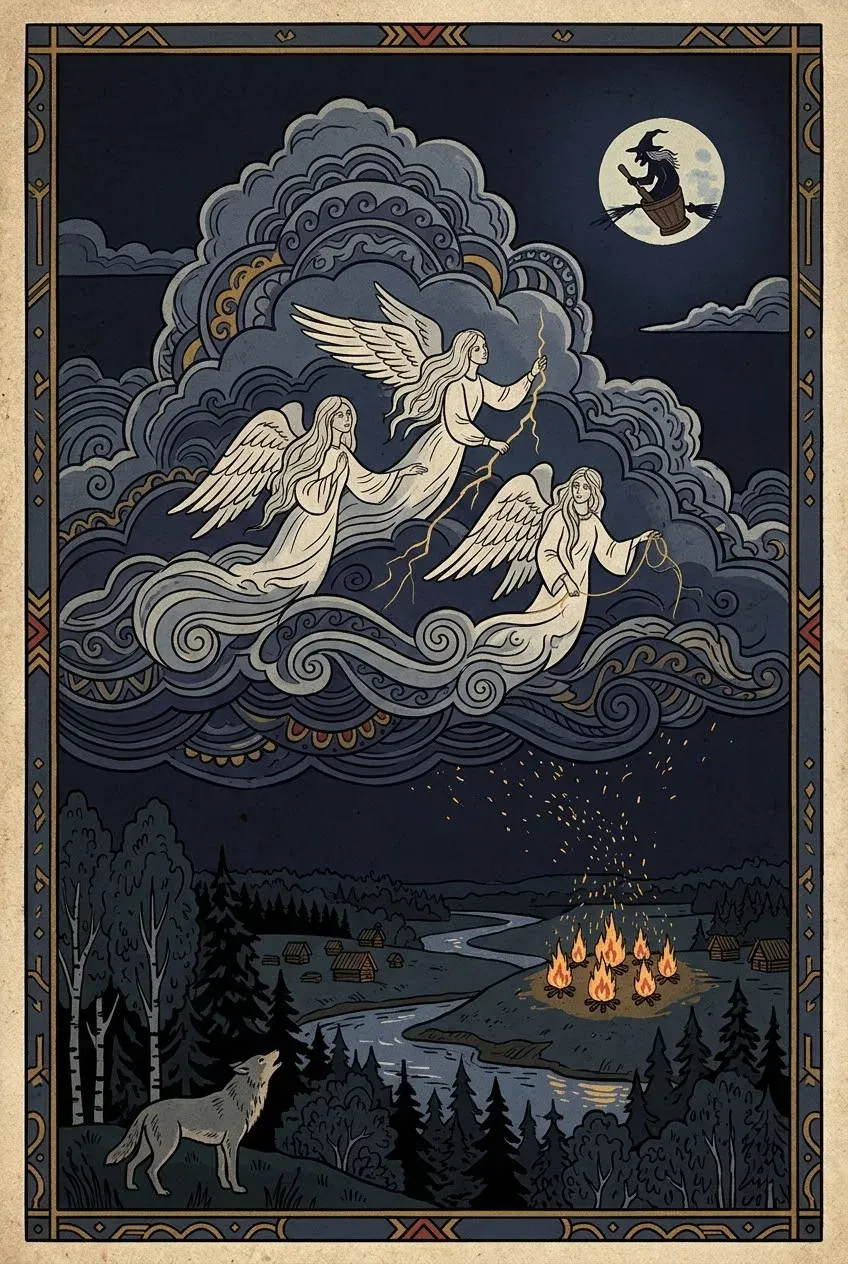
About this translation. The translation follows the first edition of 1869, including the additions and corrections to all three volumes that Afanasyev printed at its end; nothing has been left out except the index, which refers to page numbers and is replaced on this site by the search box. Afanasyev's own notes are kept, with his references expanded into readable form. His cross-references to volumes I and II give the page numbers of the original Russian edition. Afanasyev quotes many languages; quotations that he did not translate himself have been put into English, and where the scanned original was too damaged to read a foreign quotation exactly, its sense is given and a note says so. Notes added by the translator begin with Tr. Folk words are given in italic transliteration with their meaning. The translation was prepared with the help of AI and checked against the original. It does not draw on any earlier translation. The cover and the illustration at the start of the book are modern images generated with AI for this edition: they are not old artwork and do not come from the 1869 book.
Contents
- Unclean Powers (1): The Thunder God Turned Demon XXII. Нечистая сила, pp. 1–15 23 min read
Next chapter: Monday, 9 November. 46 more chapters to come. Follow via RSS.