Poetic Views of the Slavs on Nature, Volume III · Chapter 1 of 47
Unclean Powers (1): The Thunder God Turned Demon
XXII. Нечистая сила, pp. 1–15
Alexander Afanasyev · 23 min read · part 1 of 2
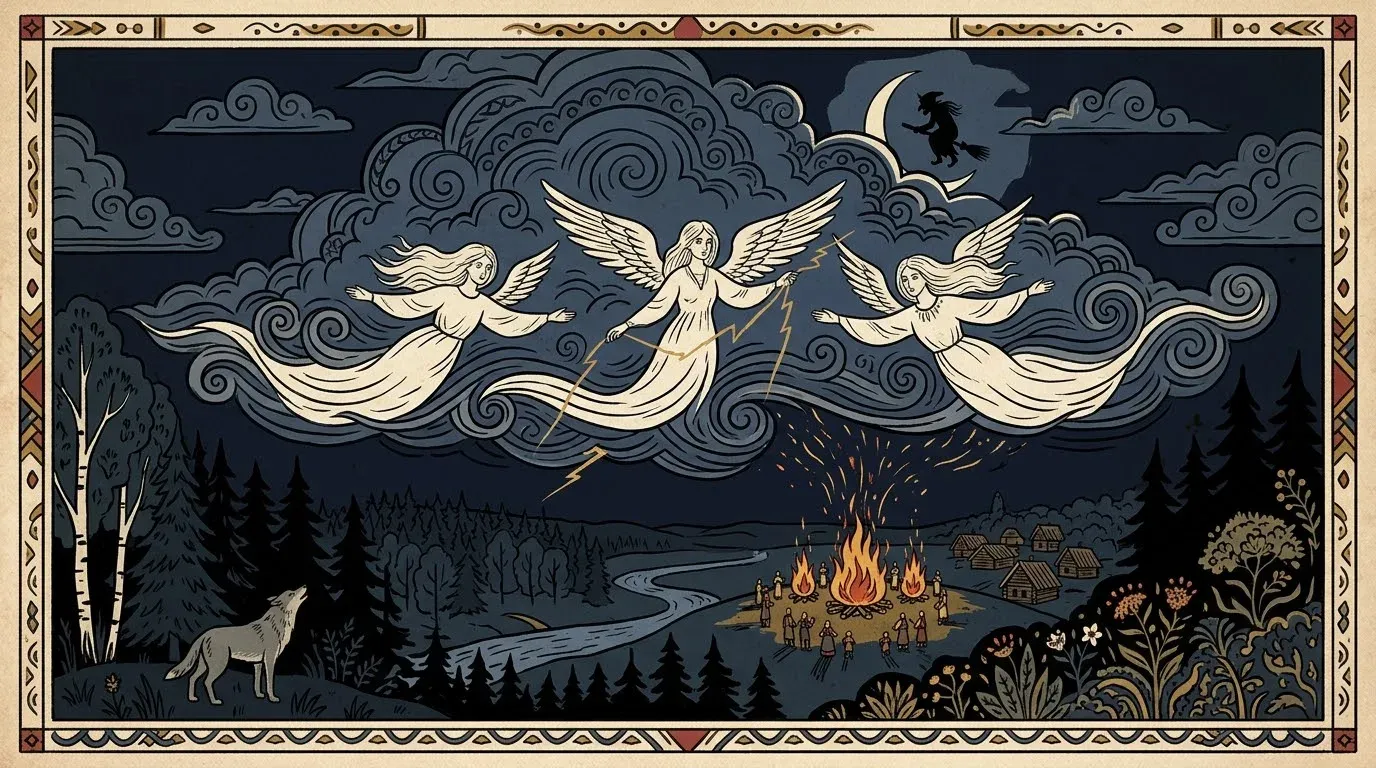
The demonic side of the thunder god
The most ancient conceptions of the thunder god have a double character. On the one hand he appears as a god of light, the smiter of demons, the creator of the world and the giver of fertility and of every good thing; on the other hand he is a cunning, malicious god who takes on a demonic aspect. This duality in the views of the primitive tribes arose under the influence of the natural qualities with which the thunderstorm shows itself: now it fertilises the earth and scatters the gloomy clouds and harmful vapours, now it sends hail and raging whirlwinds, lays waste the fields, forests and ploughland, and strikes mortals with its lightning. Travelling in the clouds, the thunder god also takes on their giant-like features, and, in keeping with the idea of the clouds as dark underground vaults, he becomes the god of the underground, infernal kingdom. To mark these different, mutually opposed sides of the thunder god's character, the people gave him corresponding by-names. In time these passed into proper names, became separate, and divided the one deity into two hostile persons. Beside the heavenly Zeus there appears another, who rules not in heaven but under the earth, the "Zeus of the underworld" (Ζεὺς καταχθόνιος): Pluto, king of the other world and of the dead.1 Beside the kindly, fruitful Thor stands the cunning Loki.
The lame god: lightning and the injured leg
Loki corresponds fully to Hephaestus (Vulcan), the god of underground fire, the skilful forger of lightning-arrows, of whom the Greek myth tells that the angry Zeus seized him by the foot and hurled him headlong from high Olympus to the earth, and that from this fall Hephaestus injured his leg and stayed lame for ever. Loki, though he is counted in the company of the Æsir and acknowledged as their comrade, is nonetheless a treacherous, deceitful being, most closely related to the demonic powers.2 Cast down from heaven and bound in chains, he shakes the earth (see vol. I, pp. 756–7); like Hephaestus, he is lame; and like him he brands the gods with spiteful mockery. An ancient tale also joins lameness with the famous smith Wieland (Völundr).3
The swiftness of lightning led people to liken it not only to flying, winged arrows, but also to legs, as the necessary instruments of movement and of nimble running. This explains why the Russian tale-epic portrays its heroes, the representatives of the spring thunderstorms, "with legs of gold up to the knee"; why the Greeks gave their goddesses the epithets "silver-footed" and "golden-footed"; and why, finally, the moving hut of the witch (that is, the drifting cloud) stands and turns on hen's legs, that is, on the legs of a cockerel, whose name (kur) is still used to mean fire (vol. I, p. 522). The mighty steeds of the heroes and the goats of Thor, striking their hooves on the cloud-rocks, struck lightning sparks from them and opened the way for the springs of rain. Since lightning falls from the heights of the air in a broken, crooked line,4 imagination began to compare its flight with the shaky, unsteady running of a lame man or beast; and to the thunderbolt it began to ascribe the bruising of heels or the injury of a leg suffered by the thunder hero when he enters the cloud-vaults to win from them the gold of the sun's rays and the living water of rain. Such a blow is dealt to him by the heavy doors of the demons' treasure-chambers or by the iron gates of hell (see vol. II, p. 686); by the door is meant here the opening which Perun's club cuts in the dark clouds. When the lightning flashes, the Czechs say that God is opening a door or a window in the heavenly hall, and that at that moment choirs of angels are singing there; that is, the song of the storm is heard.5
In the battle of Zeus with Typhon the sinews of his legs were cut. According to an Indian myth, Krishna, the famous conqueror of the dragon, was wounded in the sole of his foot, and this also explains the Greek legend of the heel of Achilles. Our tale-heroes cannot escape from the underworld except by cutting off their own calves and feeding them to the dragon or the whirlwind-bird, on whose wings they fly out into the wide world (vol. I, p. 507). The same maiming befalls the mythical animals in which the storm clouds were personified from of old. Thus Thor's goat went lame because the bone of its hind leg was broken (vol. I, p. 685), and Baldur's horse dislocated its leg at the very time when this god was accompanying Odin on his stormy ride. According to a Russian tale, when the prince was fetching the living water, the clashing mountains (the clouds) smashed the hind legs of his mighty horse (see vol. II, p. 353). In metaphorical language the fall of the lightning was expressed as the loss of the limb to which it was likened in each case: the thunder god or the cloud-demon lost his golden hair, a tooth, a finger, his phallus, a feather from his wings, or a leg. The beasts in whose shape folk traditions paint the phenomena of the storm (the dog, the hare and others) are very often represented as three-legged. German sagas make the Wild Huntsman ride a three-legged horse6 and throw down from the heights of the air the hind leg of a stag or a horse, which then turns into gold (vol. I, pp. 726–7).
Looking on the zigzag of the lightning as the crooked path on which the thunder god goes, ancient man, under the direct influence of language, joined to this image the notions of treachery and malicious cunning. In that immemorial, prehistoric age no moral or spiritual notion could be expressed except through material likenesses. So crookedness served to mean every kind of untruth, the crooked road on which an unkind, evasive, unjust man walks. To this day oboiti someone ("to go round" someone) is used in the sense of "to deceive, to beguile". Lukavyi, "cunning, malicious", literally means "bent, crooked", from the word luk, a bent bow, from which both mortals and Perun himself shoot their arrows; lukat' means "to throw, to fling"; izluchina and lukomor'e mean the bend of a river or of the sea-shore. Compare krivoi ("crooked"), krivda ("untruth") and krivodushnyi ("crooked-souled", false). In all the Celtic dialects cam means "crooked", in Welsh also "bad, evil", and in Irish "strong, mighty"; compare Welsh camu and Breton kamma, "to bend a bow".7 On the other hand the notion of truth is joined to the image of spiritual straightness: pryamit' means "to tell the truth" (naprjamki, vpryam'), and a pryamoi ("straight") man is an honest, incorruptible one, who walks the straight way.
Cunning and craft were held by the rough primitive tribes to be the essential marks of intelligence, of wisdom. Other expressions link the mind with swiftness, a notion inseparable from all the images of the elemental spirits. In the Vladimir dialect dostremit'sya (from stremnyi, stremyi, "quick, nimble") means "to guess, to grasp", and dostremlivyi means the same as doshlyi, "quick-witted, shrewd", literally "one who runs up to, who reaches the goal"; in Perm ugonka means "quick wit, guess"; with the same meaning the word dametka is used ("ne v dametku", "it did not occur to him", from do-metnut', "to throw as far as"). The Serbian hitar, identical with our khitryi ("cunning"), means "quick"; compare Slovene hiteti, "to hurry", Old Church Slavonic khytiti, "to seize, to catch"; compare Czech chvátati, the Novgorod and Tver khvatat'sya, "to hurry", Serbian dohititi, "to reach", and Russian khvat, "a fine fellow"; khapat', "to grab", and Olonets khapistyi, "dashing". So khitryi may at first have meant the same as the adjective lovkii, that is, one who catches well and quickly, and only later "clever". This series of words carries us back to those distant times of the hunting life, when the accuracy of the arrow and swiftness in pursuing game were the chief merits of a man and the guarantee of his wits.8
Unclean spirits as powers of storm and whirlwind
Alongside the word lukavyi, which became a common name for the devil (among the Germans der Böse, der Listige, der Ungetreue; among the Church Fathers ὁ πονηρός, astutus, dolosus), the word khitnik ("snatcher, robber") also serves to mean the unclean spirit, as a cunning seducer and at the same time a thief of the heavenly light and of the rains (see vol. II, p. 542), and later a thief of Christian souls; compare vor ("thief") and pro-vornyi ("nimble"). Under the influence of these views and of language, the god of the smiting lightning turns into a lame demon, and to this day various peoples go on giving the devil this epithet: der hinkende Teufel, der lahme Teufel, hinkebein, le diable boiteux,9 the lame demon, the lame devil;10 in Voronezh province and others the Unclean One is called "heelless Antipa";11 the Czechs speak of a lame god and a lame devil.12
In folk tales the devil often appears as a skilful smith, with which his black appearance and his dwelling in soot-covered caves burning with hellfire agree perfectly. In the shortest time he can forge a huge quantity of iron into nails; in Germany people think that by striking a smith's hammer at midnight one can summon the Unclean Spirit.13 The lightning-spirits falling from the cloudy sky (Czech světlonoši, "light-bearers", elves14) became mixed, in the Christian era, with those once bright angels who for their pride and arrogance were cast down, according to the Bible story, into the darkness of the abyss.15
Jacob Grimm traces the name Loki to the root luk (Latin claudere, "to lock"; claudus, "lame"); Scandinavian lok, "end, conclusion", loka, "a lock, a bolt on a door". This witness of language is curious and significant in the highest degree, since lightning was likened from of old to a key which in spring unlocks the springs of rain and locks them for the whole of the cold winter; a "closed sky" is a sky that sends no rain (see vol. II, pp. 399–405). As a demon, Loki shuts up the clouds, lays strong bolts on them, holds back the heavenly waters and brings crop failure. In contrast to Thor, the protector of farming and the grower of the grain, he sows the fields with weeds; in North Jutland a grass harmful to cattle is called Lokkens havre ("Loki's oats"), just as in Russia the sow-thistle is held to be the devil's herb: nu saaer Lokken sin havre ("now Loki is sowing his oats"). In the Middle Ages the devil was represented under the symbol of a hammer, a bolt or a lock. In the Swedish song of Thor, the devil who stole the hammer (compare vol. I, p. 688) is called Thrymer, from Scandinavian thrymr and Old High German drumil, "a bolt on a door".16
The seventh day, dedicated by the Italians to Saturn (dies Saturni), is called among the Germanic tribes Sætern-dæg, Saterdei, Saturday, Saterdag. Anglo-Saxon sætere means "a lurker", an enemy hiding in ambush, an ill-wisher lying in wait (Old High German sâzari; Middle High German sâze, an ambush). Such a name for the Saturday calls to mind Scandinavian laugardagr, Swedish lördag, Danish löverdag, which in an earlier age may have been equivalent to the forms Lokadagr, Locsdagr: a day dedicated to Loki. So Loki corresponds to Saturn, the cruel god of the underworld; and with the name of the latter, and with the name of Satan which sounds like it, the people connected their memories of an ancient national deity of demonic character. In Holy Scripture Satan is the father of lies; Scandinavian Loki means verführer, verlocker, nachsteller ("seducer, enticer, waylayer"); Danish Loke Lejemand (Loki the Liar) points to lyve, "to lie, to deceive"; and Grimm suspects a kinship between the words lygi, "lie, deceit", and logi, "fire, whirlwind". Among the Germans, Russians and Czechs there is a sign: if the fire burns with a crackle and sparks jump out of the stove, there will be quarrelling and abuse in the family. The word Wind is used to mean slander, a false accusation, and Windbeutel means a liar; in the same way in Russian "words spoken to the wind" mean idle talk, fibs, and a "windy man" is a ne'er-do-well; the Danes have a proverb: "a lie is a dangerous storm". Der Lügner is not only a liar but also a mocker, a joker, as Loki is portrayed in the tales of the Edda; and our villagers give the devil, the house spirit and the wood spirit the name of shut, shutik, "the jester, the little jester".17
Old chronicles bear witness that the Slavs too worshipped a deity like Saturn. Thus Masudi, in The Meadows of Gold, says that in a temple built on the Black Mountain stood an idol representing Saturn in the form of an old man with a stick in his hands, with which he raked the bones of the dead; under his right foot ants could be seen, and under his left sat ravens and other birds of prey. Widukind mentions a bronze idol of Saturn among the Wagrians. The Slavic name of this god, following the glosses of Vacerad, was Sitivrat (see chapter XXVIII). The Slovaks place the entrance to hell in the abysses of Mount Sitno (a name that may be connected with the name of Sitivrat), and call the evil spirit propastnik or prepadnik, "the one of the abyss".18
In general it should be noted that folk traditions and beliefs about unclean spirits picture them as demons of storm clouds and raging whirlwinds, and their hellish dwelling as the gloomy caves of the cloud-mountains. We have pointed this out more than once in the earlier chapters of this work, devoted to giants, dwarfs, water spirits, wood spirits and other elemental spirits, with whom the devils are constantly mixed up. Vritra, Ahi, Sushna and the other demons named in the Vedas are only humanised phenomena of nature, for their activity shows itself in the darkening of the sky with thunder clouds, in the raising of storms and the laying waste of the fields with hail. Living in the cloud-mountains or among the rain-waters, they steal the heavenly cows and maidens, the sun, the moon and the rain, and fight with Indra, lightning against lightning.19 In the noise of the spring thunderstorms our ancestors beheld the battle of the thunder god with the demonic powers, which he smites with his hammer, club or arrows; and there is still a belief that by striking a hammer on an anvil one can put the devil in chains.20
To the testimonies gathered on this subject above (vol. I, pp. 261–6) we shall add the witness of an old Anglo-Saxon text, similar in content to the Russian verse of The Dove Book. Here, among other things, the struggle of Satan with God is described: the devil turns into darkness, and the Lord into light; the first takes the form of a giant serpent, the second of a spear. In the end, burned by God's lightning, crushed by the thunder-chariot and pierced through by the rain, Satan admits himself beaten, and the Lord lays iron chains on him.21
Under another poetic view, the thunderstorm and the spinning whirlwinds were imagined as the devil's wedding or dance (vol. I, pp. 330–1), and to this day our villagers are convinced that winter snowstorms and blizzards are sent by the unclean power; the appearance and disappearance of devils are accompanied by storm and the crash of breaking trees. The Manichaeans and other heretics brought into their teaching the dogma that the storm is the breath of the devil bound in chains (compare vol. I, p. 311), that thunder is the gnashing of his teeth, his angry grumbling, and the rain the drops of his sweat.22 A Serbian manuscript of the fourteenth century contains a fragment of a conjuration against the unclean power, in which we read: "I forbid thee by the four patriarchs, I forbid thee, devil, by the 318 holy fathers who were at Nicaea, that thou have no power over the Christian labours (that is, over the ploughland) to rain upon them with storm and bitter hail."23
In the opinion of the Czechs, evil spirits move together with the whirlwinds that raise the dust in a column, and bring sickness on people; fighting in the air, the devils throw millstones at one another, which shatter into thousands of pieces and fall to the earth as hail. When a raging storm draws near, the Czechs conjure it with the following time-honoured formula, in which the "angels of hell" are bidden to go into the rocks and the forests, where they will harm no man, no beast, no field and no house.24 In the same way we find in the Vedas the prayer: "Do not harm us, Rudra, in our sons and grandsons, in our horses and cows!"25
A. N. Afanasyev, Poeticheskie vozzreniya slavyan na prirodu (Poetic Views of the Slavs on Nature), vol. III (Moscow, 1869), pp. 1–15.
Notes
- In the same way Persephone is the underground Hera: Juno inferna. Preller, Griechische Mythologie, I, 621–2; Grimm, Deutsche Mythologie, 945. ↩
- Jacob Grimm allows that the god Loki and the giant Logi may be one and the same (from the root of liuhan, "to shine"), Logi being the son of Fornjótr (the "old giant"). Tr.: the German of the note is badly damaged in the scan and is given here only in outline. ↩
- Grimm, Deutsche Mythologie, 220–1. Grimm notes the analogy with the fall of Hephaestus: as Hephaestus was hurled from Olympus by Zeus, so in the Edda Loki is taken for a lame god, and the smith Wieland too was lamed. Tr.: Afanasyev quotes Grimm in German; the quotation is badly damaged in the scan and is summarised. Also p. 351; Simrock, Handbuch der deutschen Mythologie, 113–15. ↩
- The Romans worshipped Mars in the form of a crooked sword: Mars falx curva. ↩
- Povesti i predaniya narodov slavyanskogo plemeni (Tales and Legends of the Slavic Peoples), 153–5; Grohmann, Aberglauben und Gebräuche aus Böhmen und Mähren, 36–37. ↩
- Schwartz, Der Ursprung der Mythologie, 140–1, 224–8; Wolf, Beiträge zur deutschen Mythologie, I, 26. ↩
- Georgievsky, The Gauls (Gally), 126. ↩
- Potebnya, 62–66. ↩
- Grimm, Deutsche Mythologie, 940–2. ↩
- Ibid., 352, 945. ↩
- Arkhiv istoriko-yuridicheskikh svedenii (Archive of Historical and Legal Information), III, part 2, 152, with the folk saying "the devil is lame, but he has little horns"; Afanasyev, Narodnye russkie legendy (Russian Folk Legends), 20. Tr.: "Antipa" is given with a question mark in the original. ↩
- Voronezhskie gubernskie vedomosti (Voronezh Provincial Gazette), 1850, no. 29. Hanuš, Děd a Děd-Vševěd, 28, 37. ↩
- Wolf, Beiträge zur deutschen Mythologie, I, 313. ↩
- Grohmann, 20: the světlonoši gather in the meadows and fields, dance, lead travellers astray and jump on their backs; they can be called up by whistling. ↩
- Lucifer, the lord of hell, was by the very meaning of his name originally a spirit of light. Grimm, Deutsche Mythologie, 937. ↩
- Ibid., 222–3, 951–2. ↩
- Ibid., 226–7, 568, 968; Grohmann, 42; Opyt oblastnogo velikorusskogo slovarya (Dictionary of Regional Great-Russian), 257 ("the black jester"), 269. ↩
- Makushev, Skazaniya inostrantsev o byte i nravakh slavyan (Foreign Accounts of the Life and Customs of the Slavs), 81–82; Chteniya of the Moscow Society of Russian History and Antiquities, year 2, III, article by Sreznevsky, 45; Kollár, Národnie zpievanky, I, 429; Sreznevsky, 17. ↩
- Mannhardt, Germanische Mythen, 167–8. ↩
- Chteniya of the Moscow Society of Russian History and Antiquities, 1865, IV, 239. ↩
- Orest Miller, Opyt istoricheskogo obozreniya russkoi slovesnosti (Historical Survey of Russian Literature), I, 332. ↩
- Kievlyanin, 1865, no. 57; Grimm, Deutsche Mythologie, 952. ↩
- Vostokov, Opisanie russkikh i slovenskikh rukopisei Rumyantsovskogo muzeuma (Description of the Manuscripts of the Rumyantsev Museum), 605–6. Tr.: "the Christian labours" is the old word for the peasants' fields and crops. ↩
- Grohmann, 33–35. Tr.: Afanasyev gives the Czech formula in the original; it is badly damaged in the scan, and only its sense is given here. ↩
- Tr.: this verse of the Rig Veda (I, 114, 8) asks Rudra, the storm god, to spare the worshipper's children, horses and cows. ↩